


Working Group & Project Information
Working group to assess options
The Recovered Water Management Solution Group has been established to assess options and recommend a viable solution for the future management of recovered water from the upgraded wastewater treatment plant in Rotorua.
Once the treatment plant upgrade is finished later this year the treatment process is expected to be among the most advanced in the country, opening up a wider range of potential uses for the highly treated wastewater, or recovered water, leaving the plant.
The solution will need to meet new regulations and standards.
The Working Group — made up of elected members, mana whenua nominees and community representatives — is responsible for assessing options and recommending a preferred solution to the council.
The group will review ideas from the community, Te Arawa entities, environmental groups, and interested parties and make initial assessments of these proposals to recommend to elected members which should be further investigated.
Purpose of the working group
- Evaluate potential solutions using a multi-criteria assessment (MCA) framework;
- Oversee investigations into shortlisted solutions;
- Assess solutions against stage 2 values;
- Recommend a preferred solution to Council.
Working group members
The Recovered Water Management Solution Working Group is made up of elected members, mana whenua nominees and community representatives — is responsible for assessing options and recommending a preferred solution to the council.
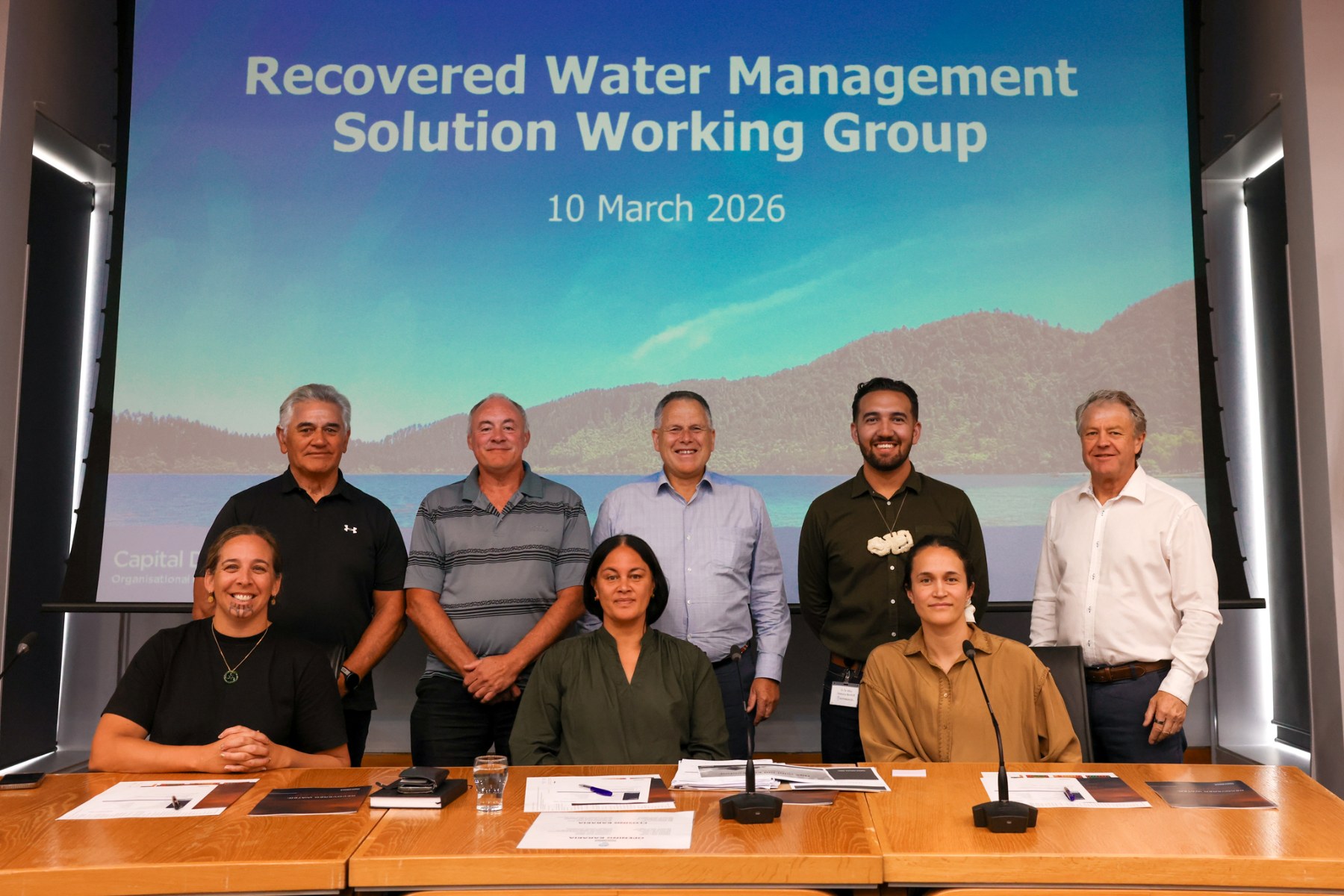
Back row from left: Wallace Haumaha, Kepa Morgan, Deryck Shaw (Chair), Councillor Te Rika Temara-Benfell, Councillor Gregg Brown, Front row from left Kerri-Anne Hancock (Deputy Chair), Deliah Balle, Hana Taipata, Not pictured: Mayor Tania Tapsell, Nona Taute and Hokimate Kahukiwa.
Rotorua Lakes Council elected members
- Mayor Tania Tapsell
- Councillor Gregg Brown
- Councillor Te Rika Temara-Benfell
Te Tatau o Te Arawa representative
- Kepa Morgan
Mana whenua nominees
- Kerri Anne Hancock (Deputy Chair)
- Deliah Balle
- Wallace Haumaha
- Haydn Marriner
Note: Mana Whenua nominees were appointed based on skillset with iwi support. They are not representatives of any iwi entity and have no obligations as mandated representatives. Their role is to advocate for mātauranga Māori and ensure a Māori worldview is reflected in decision-making.
Community representatives (appointed via Expressions of Interest process)
- Hana Taipata
- Nona Taute
- Deryck Shaw (Chair)
Project sponsor
- Stavros Michael, Group Manager Infrastructure and Assets, Rotorua Lakes Council
Working group reports
Recovered Water Management Solution Working Group Meeting - (October 15, 2025)
Summary
The Recovered Water Management Solution Working Group met for the first time on 18 October, receiving an overview of the upgraded wastewater treatment plant and the need for a long-term alternative to discharging treated wastewater through the Whakarewarewa Forest.
The upgrade underway will deliver high quality recovered water using phosphorus removal, ultra filtration, and UV treatment, along with increased capacity for future growth. The group will explore a full range of new long-term solutions. Members were introduced to a two stage Multi Criteria Analysis framework to guide option assessment. Stage 1 is a pass/fail screen covering feasibility, regulatory compliance, and budget alignment.
Options that succeed move to Stage 2, where mana whenua values, environmental outcomes, lifecycle cost, community support, and risks are assessed. Engagement with iwi, hapū, technical experts, and local stakeholders will shape the recommendations, with a preferred option expected to go to Council in early 2027.
(Link to presentation is below)
Meeting Minutes - October 15, 2025
Recovered Water Management Solution Working Group Meeting (February 3, 2026)
The Recovered Water Management Working Group met on 3 February to continue building a shared understanding of all past assessments relating to recovered water discharge options.
A comprehensive overview of previously explored discharge solutions was presented, including discharge to land, Puarenga Stream after land contact, shoreline and deep lake outfalls, and an earlier preferred option involving a land contact bed flowing to the Te Arikiroa Channel.
The presentation revisited the factors that influenced past decisions, such as cultural impacts, environmental considerations, land availability, cost, and stakeholder feedback. Potential discharge sites across the wider catchment were also outlined.
Te Rerekohu Awerangi Tuterangiwhiu was confirmed as the Mātauranga Māori Specialist supporting the project. Te Rerekohu will bring mātauranga and cultural expertise into the assessment process and will present to the Group at its March hui.
The Group was also updated on the current engagement process, with the public submission platform now open until 16 March 2026. Three submissions had been received to date, with early themes including suggestions for industrial use of recovered water, proposals to relocate discharge away from the Whakarewarewa Forest, and concerns about any recovered water entering Lake Rotorua.
Recovered Water Management Solution Working Group Meeting - (November 21, 2025)
Summary
At its 21 November meeting, the Working Group received presentations on the wastewater treatment plant upgrade and the challenge of managing emerging organic contaminants.
The upgrade will deliver “limit of technology” performance, including advanced membrane ultrafiltration, UV disinfection, and significant nutrient reductions, producing recovered water suitable for unrestricted non‑potable reuse under international guidelines.
The group’s role is to recommend a sustainable, culturally aligned, environmentally sound solution for managing this high‑quality water.
The Working Group was also given an overview of emerging organic contaminants such as pharmaceuticals, microplastics, and endocrine-disrupting chemicals.. While advanced treatment significantly reduces these compounds, some persist at low levels.
(Link to presentation is below)
Presentation
Meeting Minutes - November 21, 2025
Recovered Water Management Solution Working Group Meeting (December 18, 2025)
Summary
The Working Group met on 18 December to continue planning for how Rotorua will manage recovered water from the upgraded treatment plant.
Regional Council staff outlined decades of research and the nutrient limits required to restore Lake Rotorua to pre‑1960s conditions, noting major improvements driven by land‑use changes, wetlands, and the long‑running use of Whakarewarewa Forest irrigation.
Once the current upgrade of the treatment plant is complete, nitrogen and phosphorous levels from the plant will be below the prescribed limits . Wastewater willaccount for only about 5% of the nutrient load going into the lake.
The Working Group will now progress its Multi‑Criteria Analysis, with Stage 1 underway and a Council decision expected in June 2026.
Members stressed transparency, iwi involvement, and balanced consideration of cultural values, environmental outcomes, affordability, and long‑term sustainability to ensure solutions meet the needs of both Te Arawa and the wider Rotorua community.
(Link to presentation is below)
Meeting Minutes December 18, 2025
Recovered Water Management Solution Working Group Meeting (February 3, 2026)
Summary: The Recovered Water Management Working Group met on 3 February to continue building a shared understanding of all past assessments relating to recovered water discharge options.
A comprehensive overview of previously explored discharge solutions was presented, including discharge to land, Puarenga Stream after land contact, shoreline and deep lake outfalls, and an earlier preferred option involving a land contact bed flowing to the Te Arikiroa Channel.
The presentation revisited the factors that influenced past decisions, such as cultural impacts, environmental considerations, land availability, cost, and stakeholder feedback. Potential discharge sites across the wider catchment were also outlined.
Te Rerekohu Awerangi Tuterangiwhiu was confirmed as the Mātauranga Māori Specialist supporting the project. Te Rerekohu will bring mātauranga and cultural expertise into the assessment process and will present to the Group at its March hui.
The Group was also updated on the current engagement process, with the public submission platform now open until 16 March 2026. Three submissions had been received to date, with early themes including suggestions for industrial use of recovered water, proposals to relocate discharge away from the Whakarewarewa Forest, and concerns about any recovered water entering Lake Rotorua.
The presentation and minutes from this meeting are not being made publicly available on the grounds contained in Section 48(1) of the Local Government Official Information and Meetings Act, namely:
- Making the information public would breach individual’s privacy – LGOIMA Section 7(2)(a)
- Making the information public would affect Council’s ability to negotiate commercially – LGOIMA Section 7(2)(i)
Recovered Water Management Solution Working Group Meeting (March 10, 2026)
Executive summary:
The Working Group received a presentation from Mātauranga Māori Specialist Te Rerekohu Tuterangiwhiu, who grounded the discussion in the Te Ao Tūroa framework of whakapapa, mauri, and mana, as well as wao atua, wao tangata and wao tūpuna.
Te Rerekohu explained how kaitiakitanga was an active, relational responsibility—enhancing natural processes rather than merely stewarding them.
He encouraged the group to consider how recovered water can be reintegrated into whakapapa in a way that restores its function, rather than being treated as a sterile by-product.
He emphasised the importance of solutions that reflect local whakapapa, catchments and marae. Members of the Working Group acknowledged the need to find a solution that honours both mātauranga Māori and technical requirements.
These insights will guide the next phase of assessment as the Working Group prepares to shortlist discharge options for Council consideration.
Stage 1 Screening Criteria
Following the presentation, the Working Group began its initial assessment of both previously investigated options and the submissions received against the Stage 1 screening criteria. These criteria focus on:
- Technical feasibility
- Regulatory feasibility
- Budget alignment
This first pass provides an early indication of which options may be viable to progress into Stage 2.
Next Steps
Over the coming weeks, the Working Group will undertake site visits and continue to assess the long list of options and submissions against the Stage 1 criteria. This work will inform the Group’s recommendation to Council, which is scheduled for June 2026, identifying which options should proceed to Stage 2 for more detailed technical, cultural, and environmental assessment
The minutes from this meeting are not being made publicly available on the grounds contained in Section 48(1) of the Local Government Official Information and Meetings Act, namely:
- Making the information public would breach individual’s privacy – LGOIMA Section 7(2)(a)
- Making the information public would affect Council’s ability to negotiate commercially – LGOIMA Section 7(2)(i)
Recovered Water Management Solution Working Group Meeting (April 7, 2026)
Executive summary:
To allow more time for public input, the Recovered Water Management Solution Working Group decided to extend the deadline for submitted ideas for recovered water to April 26, 2026.
The extension was intended to encourage broader participation and give people more time to bring forward ideas.
Prior to the extension the Working Group — made up of elected members, mana whenua nominees and community representatives — was told that twelve submissions were received in total.
Stage 1 Screening Criteria
Prior to the decision to extend the period for public input, the Working Group began its initial assessment of both previously investigated options and the submissions received against the Stage 1 screening criteria.
The presentation and minutes from this meeting are not being made publicly available on the grounds contained in Section 48(1) of the Local Government Official Information and Meetings Act, namely:
- Making the information public would breach individual’s privacy – LGOIMA Section 7(2)(a)
- Making the information public would affect Council’s ability to negotiate commercially – LGOIMA Section 7(2)(i)
Recovered Water Management Solution Working Group Meeting (May 5, 2026)
Executive summary:
Bay of Plenty Regional Council advised that the Rotorua geothermal system and is actively managed to protect sensitive geothermal features and customary values and is operating close to its sustainable limits
Current reinjection volumes are significantly lower and much hotter than the very large volumes of cold recovered water being considered.
Injecting recovered water at scale (around 20,000 tonnes/day at 15–25°C) could cool the aquifer, alter its chemistry, risk over‑pressurisation and hydrothermal eruptions, and impact existing complex wells infrastructure.
BOPRC said the system was managed to protect the taonga and the focus was on keeping the aquifer full and hot. Injecting cold water or using heat as scale could risk cooling.
Previous modelling suggests effects on surface features and the recovery of the system would be significant.
The Working Group also received an update on ideas for potential solutions for recovered water.
The platform for public submissions was extended to 26 April and received 13 additional submissions as a result. Twenty-five submissions were received in total.
Stage 1 Screening Criteria
Following the presentation, the Working Group continued its assessment of both previously investigated options and the submissions received against the Stage 1 screening criteria.
The presentation and minutes from this meeting are not being made publicly available on the grounds contained in Section 48(1) of the Local Government Official Information and Meetings Act, namely:
- Making the information public would breach individual’s privacy – LGOIMA Section 7(2)(a)
- Making the information public would affect Council’s ability to negotiate commercially – LGOIMA Section 7(2)(i)
Recovered Water Management Solution Working Group Meeting (June 9, 2026)
Executive summary:
The Working Group continued its assessment of both previously investigated options and the submissions received against the Stage 1 screening criteria.
At the end of the meeting, the Working Group finalised which options would be recommended to elected members for further investigation in Stage 2 of the project. Members of the Working Group were positive about the progress made to date.
No decisions have yet been made, and Council expects to consider the Working Group’s final recommendations by December 2026
The presentation and minutes from this meeting are not being made publicly available on the grounds contained in Section 48(1) of the Local Government Official Information and Meetings Act, namely:
- Making the information public would breach individual’s privacy – LGOIMA Section 7(2)(a)
- Making the information public would affect Council’s ability to negotiate commercially – LGOIMA Section 7(2)(i)
Recovered Water Management Solution Working Group Meeting (July 7, 2026)
July 7: The Recovered Water Management Working Group met in June to consider two additional perspectives on recovered water management.
Dr Kēpa Morgan presented a Mauri-based assessment of three recovered water discharge options: Te Arikiroa Channel, wetland discharge, and land infiltration (whenua).
Using the Mauri Model, which he described as a framework for assessing infrastructure through a framework that evaluated environmental, cultural, social, and economic impacts over a 50-year period.
The model evaluates whether infrastructure enhanced the mauri of the communities it serves across four measures:
- Taiao (Environmental)
- Tangata/Hapori/Whānau (Social and Community)
- Tikanga/Hapū-Iwi (Cultural)
- Whairawa (Economic)
The assessment concluded that land infiltration delivered the most positive outcomes within the assessment framework, while the wetland and Te Arikiroa Channel options generated negative cumulative mauri impacts.
The presentation emphasised the importance of assessing infrastructure decisions through both Te Arawa values and conventional planning considerations.
Councillor Don Paterson also presented information on emerging modified pine bark technology developed from forestry by-products.
Research from Finland and New Zealand was highlighted, demonstrating the potential for magnetite-modified pine bark to remove pharmaceutical residues, and other emerging organic compounds.
Cr Paterson told the Working Group that feedback from Scion researchers indicated that New Zealand radiata pine could be well suited to this application and that sufficient material would be available. The presentation suggested the technology could warrant further investigation as an additional treatment step for recovered water.
His presentation suggested that following the additional treatment the recovered water could be piped to a constructed wetland near the treatment plant for further polishing.
Her told the Working Gorup modified bark technology offered a scientifically proven, locally sourced solution that can deliver cleaner water, stronger environmental outcomes, enhanced biodiversity recreational benefits and long-term value for ratepayers.
The Working Group continued its assessment of both previously investigated options and the submissions received against the Stage 1 screening criteria. The sites remain confidential while Council is in discussions with landowners.
No decisions have yet been made, and Council expects to consider the Working Group’s final recommendations by December 2026
The minutes from this meeting are not being made publicly available on the grounds contained in Section 48(1) of the Local Government Official Information and Meetings Act, namely:
- Making the information public would breach individual’s privacy – LGOIMA Section 7(2)(a)
- Making the information public would affect Council’s ability to negotiate commercially – LGOIMA Section 7(2)(i)
Presentation: Analysis Mauri-based Assessment of Infrastructure Belonging.
Presentation: Modified Pine Bark Technology as Additional Polishing Stage
Recovered Water Management Solution Working Group Meeting (August 4, 2026)
August 4: The Recovered Water Working Group met on 4 August 2026 to discuss Stage 2 of the project, including Te Arawa engagement, cultural assessment and the next phase of project investigations.
The meeting opened with an acknowledgement of the passing of Te Arawa elder and Working Group member Hokimatemai Kahukiwa.
Councillor Te Rika Temara-Benfell and Working Group Chair Deryck Shaw recognised Mr Kahukiwa’s contribution to the project and advocacy for his iwi and hapu.
The Working Group heard a presentation from Ngāti Rangiwewehi representative Nicki Douglas, who outlined a list of key Te Arawa concerns in relation to the project
Ms Douglas, supported by Te Rangikaheke Bidois and Jacqui Mackle, emphasised the importance of maintaining the principles established through Treaty settlements and the 2020 Kawenata.
Ms Douglas said Te Arawa participated as a Treaty partner and statutory co-governor, and she reiterated the position that treated wastewater should not be discharged into Lake Rotorua.
She also cautioned against selecting a solution on the basis of lower capital costs or compliance requirements which could create long-term environmental risks and undermine investments already made to improve lake health.
Ms Douglas identified four areas requiring consideration: an explicit commitment to no treated wastewater discharge into Lake Rotorua; greater weighting of cultural impacts, mauri and environmental values in the multi-criteria assessment process; stronger assessment of emerging contaminants, including PFAS, pharmaceuticals and other micro-pollutants; and greater consideration of circular-economy opportunities, including commercial or industrial reuse, wetland restoration and other nature-based systems.
Discussion also focused on engagement during Stage 2. Ms Douglas emphasised the importance of early, transparent engagement with Te Arawa entities, iwi and hapū so concerns could be identified and addressed before options were developed further.
Working Group members supported a structured approach that would enable Te Arawa to understand, test and influence options before decisions were made.
Council staff outlined engagement undertaken during Stage 1 and the approach planned for Stage 2.
Engagement to date has included discussions with iwi and parties connected to potential locations under investigation.
These conversations had focused on sharing information, understanding interests and concerns, and helping to shape future investigations. Communication through newsletters and project updates will continue as the project progresses.
Staff also reported work was underway to assess soil contaminant levels at the current discharge site. Further work in examining PFAS and pharmaceuticals entering the plant through solid and liquid waste, including whether hospital discharges contribute, and whether upstream interventions are possible.
Mātauranga Māori expert Te Rerekohu Tuterangiwhiu outlined the role that cultural assessment and mātauranga Māori would play in Stage 2.
He discussed the importance of identifying cultural non-negotiables early and placing them alongside technical, environmental and engineering requirements.
He supported using cultural assessment, mātauranga Māori and wānanga to inform future investigations and decision-making.
The Working Group continued its assessment of both previously investigated options and the submissions received against the Stage 1 screening criteria. The sites remain confidential while Council is in discussions with landowners.
No decisions have yet been made, and Council expects to consider the Working Group’s final recommendations by December 2026
The minutes from this meeting are not being made publicly available on the grounds contained in Section 48(1) of the Local Government Official Information and Meetings Act, namely:
- Making the information public would breach individual’s privacy – LGOIMA Section 7(2)(a)
- Making the information public would affect Council’s ability to negotiate commercially – LGOIMA Section 7(2)(i)
Recovered Water Management Solution Working Group Meeting (September 8 2026)
Executive Summary
September 8: The Recovered Water Working Group met on 8 September 2026 to receive an engagement process update, hear a presentation from Working Group member Dr Te Kēpa Morgan on a mauri-centred infrastructure concept, meet the newly appointed Stantec consultant team, and discuss the practical application of Council-approved weightings to the Multi-Criteria Assessment (MCA) Stage 2 process required to determine a preferred option(s) for recommendation to Council.
The meeting opened with the welcome of mana whenua nominated representative Haydn Marriner, who has been appointed to the Working Group following the passing of respected Te Arawa elder and Working Group member Hokimatemai Kahukiwa.
The Working Group received an update on Stage 2 engagement activities to-date, including discussions with landowners of shortlisted sites and their governance entities on whether sites should remain under detailed assessment status.
Several sites, which remain confidential while discussions take place, continue to progress through feasibility investigations, while others have been removed following feedback from landowners and relevant stakeholders.
Staff also noted ongoing feedback from iwi, hapū and landowners, including opposition to direct discharge into Lake Rotorua and a desire for future discharge solutions to help deliver additional environmental value outcomes and equitably sharing costs, risks and benefits across the community.
A key focus of the meeting was Dr Morgan's presentation, Te Kaha a Rotorua Nui a Kahumatamomoe: An Integrated Ecologically Sustainable Land-based Discharge Solution for Rotorua City.
The presentation suggested that a land-based low-rate infiltration discharge model would divert recovered water some distance from Lake Rotorua. Such options, according to the presentation would require 200ha of land and Dr Morgan told the meeting this approach would better positioned to achieve long-term environmental, cultural, social and economic outcomes.
Key themes of the proposal included:
- Noting the cumulative impacts of historical wastewater disposal (cased in the 1980s) and general catchment pressures on the mauri of Te Rotorua-nui-a-Kahumatamomoe.
- Noted concerns regarding nutrients, traces of PFAS, pharmaceuticals, microplastics and other compounds entering the aquatic environments.
- Suggested the use of a Mauri Model framework to assess long-term environmental, cultural, social and economic outcomes and inform the preferred option.
- An "Infrastructure Belonging" approach that aligns infrastructure decisions with intergenerational wellbeing and enhancement of mauri.
- Explore opportunities to generate value through the beneficial reuse of recovered water.
The Working Group also received an introduction to the Stantec consultant team and an overview of its approach to Stage 2 investigations, including the solutions concept development, options costings, identified constraints assessments and preparation of information to support the MCA process.
Members then considered how the Council-approved MCA weightings will be applied to the remaining recovered water options as the project moves into its next phase of detailed evaluation. Discussion focused on whether the approved weightings appropriately reflected project priorities, particularly in relation to mana whenua considerations and aligned with Council’s statutory and wider community interests.
A number of recommendations were made, including arranging a hui to update the community on the project, and to further socialise the weightings application of the MCA criteria.
Next meeting: 6 October 2026.
The minutes from this meeting are not being made publicly available on the grounds contained in Section 48(1) of the Local Government Official Information and Meetings Act, namely:
- Making the information public would breach individual’s privacy – LGOIMA Section 7(2)(a)
- Making the information public would affect Council’s ability to negotiate commercially – LGOIMA Section 7(2)(i)
PRESENTATION: Mauri Centered Infrastructure - Dr Kepa Morgan
Meeting overview document
Te Arawa Cultural Values Framework
Recovered Water Management Solution Working Group Meeting (October 6, 2026)
The Recovered Water Working Group met on 6 October 2026 to receive updates on engagement activities, review technical investigations into potential recovered water management options, consider environmental monitoring results, and discuss the project's Multi-Criteria Assessment (MCA) framework
The Working Group received an update on engagement with landowners and mana whenua. Members discussed the time constraints for landowners to consider information, undertake their own discussions, and participate meaningfully in the process. The relationship between project timeframes and Long-Term Plan requirements was also discussed, along with the need for broader community understanding and engagement as the project progresses.
Technical advisors from Stantec presented an update on Stage 2 investigations. Several potential land-based and wetland treatment concepts are being assessed, with investigations continuing into environmental performance, engineering requirements, costs, risks and long-term outcomes.
Members discussed a range of technical matters, flow paths, including treatment performance, retention times as well as the importance that the options enhance the mauri of water, recognise cultural values, and deliver positive long-term outcomes.
The Working Group also received the results of a recent investigation into metals and PFAS concentrations in soil within the existing Land Treatment System in Whakawerawera Forest.
Testing found metal concentrations after 35 years of irrigation were low and similar with background rural soil levels - even the highest concentrations found in the topsoil were well below guideline values. PFAS concentrations were also very low and substantially below ecological and public health guideline values. It was also noted that recent test results indicate the levels in kākahi in Lake Rotorua are not an issue based on the NZ PFAS screening criteria. Members discussed the importance of ongoing environmental monitoring and ensuring any future recovered water solution is supported by appropriate monitoring programmes.
The Working Group also discussed the proposed Multi-Criteria Assessment (MCA) framework, including the cultural, environmental, community, cost and implementation considerations, and weightings. The Working Group mentioned the importance of receiving feedback from mana whenua to inform their assessment.
Some presentations and the minutes from this meeting are not being made publicly available on the grounds contained in Section 48(1) of the Local Government Official Information and Meetings Act, namely:
- Making the information public would breach individual’s privacy – LGOIMA Section 7(2)(a)
- Making the information public would affect Council’s ability to negotiate commercially – LGOIMA Section 7(2)(i)
Metals and PFAS Summary Tables and Key Points
Cultural Considerations Report

Decision-making framework
A structured evaluation framework—Multi-Criteria Analysis (MCA)—is being applied to ensure rigour and transparency in decision-making.
The MCA framework is structured in two stages:
Stage 1 – Pass/fail criteria
Solutions must meet all Stage 1 criteria (below) to proceed.
• Technical feasibility.
• Legal and regulatory compliance.
• Fits within Council’s Long Term Plan allocated budget or less.
The working group will assist the project team in defining the scope of investigations and will receive monthly updates. Once sufficient information is gathered, the group will initiate the Stage 1 analysis.
The results will be presented to Council for approval to proceed to Stage 2.


Stage 2 – Values assessment
Solutions that pass Stage 1 will undergo detailed investigation and reporting. The working group will then conduct a values-based assessment using approved weightings outlined below:

The outcome will be a recommended solution or shortlist presented to Council for final approval
Once Council selects and approves a solution, the project will exit the MCA decision-making phase.
The project team will then lead the approved solution through detailed design, consenting, procurement, construction, commissioning, and handover to operations
Frequently asked questions
What is the history of the discharge location?
In 1991, treated wastewater began being discharged into Whakarewarewa Forest via irrigation blocks for further land-based treatment.
Treated wastewater is sprayed into the forest and seeps through land in the Purenga catchment before ultimately discharging into Lake Rotorua.
Cultural concerns from tāngata whenua prompted the Environment Court in 2013 to direct Rotorua Lakes Council (RLC) to investigate alternatives.
In response, Council signed a deed committing to end forest spraying by 2019. In 2014, the Rotorua Project Steering Committee (RPSC) was formed to explore new discharge options.
The committee included iwi and hapū representatives, technical experts, and council officials, and placed strong emphasis on cultural impact assessments.
The committee considered a range of possible ecosystem discharge solutions out of the forest including:
• Rapid filtration beds;
• Monitoring ponds;
• Gabion basket infiltration (rocks and baskets);
• Various wetland configurations including engineered wetlands and floating wetlands;
• Direct to water.
After extensive consultation and feasibility studies, a Land Contact Bed system was selected as the preferred discharge method. In late 2018, Te Arawa Lakes Trust opposed the proposed discharge into Te Arikiroa Channel and Lake Rotorua via the contact bed, citing cultural and environmental concerns
This opposition led to a collaborative agreement in 2020 between RLC, CNI Iwi Holdings, and Te Arawa Lakes Trust.
The Kawenata agreement allowed for a temporary discharge in the Whakarewarewa Forest while a long-term solution was developed. In early 2025, RLC opened the discussion around selecting a new discharge site to a wider community group, seeking broader input and guidance. As of mid-2025, recovered water from the Wastewater Treatment Plant is still being discharged to the forest site, but only until a new discharge solution is in place.
The final discharge location will be determined once a new solution is agreed upon, designed, consented, and commissioned
What is recovered water?
It is mainly made up of fully treated wastewater generated from homes, industry and businesses and during heavy rainfall (stormwater). About 90% of wastewater is water and about 10% is other material including human waste.
Fully treated wastewater or recovered water is then discharged via an approved system.
Currently the recovered water from Rotorua city’s treatment plant is pumped to Whakarewarewa Forest and discharged there via an irrigation system, with agreement of the landowners and mana whenua and under a resource consent.
This system will no longer be needed after the plant upgrade, and it is no longer supported by the landowners and a new alternative needs to be found.
What has Council decided in relation to finding a long-term solution for recovered water?
A new working group has been tasked to come up with a recommended long-term solution.
Council has approved the composition and the terms of reference for the working group, along with the proposed staged approach for the group’s work and the criteria framework for assessing potential solutions.
Read the report that was considered by Council to assist in its decision-making here: Late Items Agenda of Council Meeting - Wednesday, 23 July 2025
How was the working group established?
The Recovered Water Management Solution Working Group was established by Rotorua Lakes Council to recommend a long-term solution for managing the city’s recovered water.
- Council appointments: Mayor Tania Tapsell and Councillors Gregg Brown and Te Rika Temara-Benfell were appointed at the Council meeting on 26 November.
- Mana whenua nominees: Four members were appointed earlier in the process based on their expertise and with iwi support.
- Community representatives: Three members were selected through an Expressions of Interest process.
- Te Tatau o Te Arawa: A representative of Te Tatau o Te Arawa was appointed.
- Council staff: Provide technical and administrative support.
The group brings together mana whenua, community voices, technical experts, and elected representatives to ensure the recommended solution reflects cultural values, environmental priorities, and community aspirations.
What is the quality of recovered water that comes out of Rotorua city’s wastewater treatment plant?
The current Wastewater Treatment Plant is among the best in the country, treating wastewater to a very high standard. It is being future-proofed to meet higher projected demand and to continue to reduce and maintain nutrient levels below targets agreed under the Rotorua Te Arawa Lakes Programme.
The current plant treats water to an extremely high standard and the upgraded plant will significantly further improve the quality of the treated water. This will include a higher level of nitrogen and phosphorus removal and full disinfection of bacteria such as E. Coli. It is expected that the recovered water will be certified for all uses except drinking standards.
How do I submit a potential solution for the future management of recovered water?
Council launched an online submission page on its Participate platform to receive potential solutions from the community, Te Arawa entities, environmental groups and other interested parties. Twenty-six submissions were received and the submission period is now closed.
What was the timeline for submitting ideas to the working group?
The period for submitted ideas for the Recovered Water Project has now closed. The deadline was extended to 26 April, 2026 and 26 submissions were received in total.
The Recovered Water Management Solution Working Group is now assessing previously investigated options and public submissions against the Stage 1 screening criteria.
No decisions have yet been made.
What options have been shortlisted for detailed assessment?
A short-list of recommended concepts for managing recovered (treated) water from the city’s upgraded wastewater treatment have progressed to detailed assessment.
The Working Group group has assessed a range of ideas submitted by the public as well as some that have been previously explored.
The Working Group recommended options it considered technically and financially feasible, and that could meet regulatory requirements, to Council’s Infrastructure Committee.
The recommended options include a mix of approaches, such as passing recovered water through nature-based pathways such as land or wetlands,and incorporating different forms of carbon to further remove micropollutants (emerging contaminants).
The Committee approved the recommended options which were discussed in the public excluded section of the meeting for commercial and privacy reasons. Council is in discussions with landowners.
The focus is now on discussing the shortlisted options with landowners and, if there is agreement, site investigations and design work will be carried out.
Has Council already determined a preferred option or decided on a proposal/plan?
No. The working group is still assessing the options and ideas it has received from the community.
No decisions have yet been made.
When will a decision be made?
Once the working group has finished assessing viable options it will make a recommendation to Council about which options it considers should be investigated further.
The options Council wants to progress with will then go back to the working group for further investigation and the group will then recommend a preferred option for Council decision-making.
Once Council has decided on its preferred option, this will be consulted on with iwi and the wider community before a consent application is made.
A decision on a preferred option is expected to be made by the end of the year with consultation then to follow.
The outcome of that will then feed into development of the 2027-2037 Long-term Plan and consultation on that is expected to be held around April next year.
Has the Working Group formally excluded direct lake discharge and sensitive spring/aquifer systems?
Based on the feedback obtained through the engagement process, the Working Group has decided not to progress direct discharge to the lake as an active option.
The Working Group’s recommendation against direct discharge will be explicit and reasoned when advice is provided to Council, including the cultural, environmental and Treaty-relationship implications of such an option.
It is important to note that the Working Group has an advisory role. While it can recommend what options should or should not be considered, it cannot pre-determine the final decision which will be made by Rotorua Lakes Council elected members.
Under the Local Government Act, Council must consider all reasonably practicable options when making a decision.
The report accompanying the Working Group’s recommendations will provide elected members with information on the relevant options, including their advantages and disadvantages to support informed decision-making.
This means that, at this early stage, no option can be formally removed from the statutory decision-making pathway.
Elected members are expected to select a preferred option in December 2026.
Sensitive spring and aquifer systems can be treated differently.
Protection of these environments can be built into the Stage 2 assessment as a hard constraint within site-selection criteria, and this will be made explicit in the Stage 2 scope.
The Council’s commitment to adhere to the nitrogen levels allocation for the Treatment Plant per year is the design target of the upgraded treatment plant.
While other sources of nitrogen loss to the lake are managed by the BOPRC’s Land Management programme, the Council is committed to reduce sewerage nominal nitrogen currently generated by the community from some 380 tN p.a. to the allocated level, removing around 350 t of N p.a.
This is embedded and non-negotiable. The design target of about 30t p.a. represents about 7% of the agreed sustainable nitrogen levels for the lake of 435tN p.a.
The community has invested, with the completion of the WWTP upgrade over $200 million to achieve and sustain these targets.
In terms of over water flows to the lake and erosion risks, it is important to note that dry weather inflows to the lake are about 3.8mil cubic meters per day. Recovered water, that eventually arrives at the lake after land-based treatment, would represent less than 0.6% of these dry weather inflows to the lake.
Erosion mitigation is best pursued through better lake level management controls, something Council is exploring with the BOPRC and the Rotorua Te Arawa Lakes Strategy Group
How were mauri and cultural values weighted and what cultural impact assessments were done before shortlisting options.
Cultural values and mauri considerations were built into the Multi Criteria Analysis (MCA) framework approved by Council. In Stage 1, the assessment was a pass/fail screening, not a weighted scoring exercise.
The purpose of Stage 1 was to identify which concepts were technically feasible, had a clear viable regulatory pathway, and were broadly consistent with cultural, environmental, and operational parameters.
Because of that structure, cultural considerations were embedded in the screening criteria rather than expressed as a numerical weighting against CAPEX (capital expenditure for constructing new assets or major upgrades) or OPEX (operational expenditure for ongoing running, maintenance and lifecycle costs).
Stage 2 is where weighted MCA scoring will occur, and cultural and mauri-based criteria will sit alongside environmental, technical, and overall cost considerations.
The Working Group has drawn on specialist expertise in mauri-based assessment to help interpret and apply those criteria, ensuring te ao tawhito and te ao hurihuri inform the assessment.
No Cultural Impact Assessments (CIAs) were completed prior to Stage 1 shortlisting.
CIA considerations will be applied once specific site locations and anticipated effects can more crystalised. The project is still in its early stages, and Stage 1 was not at a level of detail where CIAs would normally be undertaken.
How do the shortlisted concepts address PFAS, micro-pollutants and CECs beyond tertiary, and what long-term liability testing is in the consultant scope
The upgraded Wastewater Treatment Plant represents a significant step forward for Rotorua.
It is designed to recover water from the wastewater influent at a quality that meets all current regulatory standards, including for PFAS, micro-pollutants and other emerging non-water compounds (CECs).
No treatment process anywhere in the world fully eliminates all PFAS and CECs. That is the state of the science, and it is why the shortlisted concepts do not rely on tertiary treatment alone.
Each of the concepts that has progressed includes additional treatment layers beyond the upgraded plant.
These include land-based treatment systems such as wetlands, carbon-based polishing, soil-based filtration and other natural or engineered processes that provide further reduction of CECs.
This multi-layered approach is designed to ensure that the recovered water receives treatment well beyond tertiary standards and before reaching the receiving environment.
At this stage of work, the focus is on eliminating possible discharge options rather than finalising long-term recovered water management frameworks.
Council remains open and alert to improvements in science and technology, and any future changes in standards or treatment capability will be incorporated as the project develops and in future operations.
This ensures the final solution is adaptable and able to respond to advances in knowledge over time.
You can read more about PFAS in a dedicated FAQ below
To what extent are circular economy options being actively priced and designed, not just standard disposal fields?
Circular economy opportunities are being considered as part of an integrated approach rather than as stand-alone alternatives.
The upgraded Wastewater Treatment Plant will produce high-quality recovered water, and the shortlisted concepts build on that through additional treatment layers such as wetlands, carbon-based polishing and soil-based filtration.
These approaches support potential re-use pathways, environmental enhancement opportunities and long-term service resilience.
Industrial and commercial re-use opportunities are being explored.
Current assessment indicates they represent a relatively small proportion of the total recovered water volume (about 5%).
For that reason, circular economy options are being developed alongside, rather than instead of, the primary land-based discharge solutions.
This ensures the final programme can support beneficial re-use where it is viable, while still providing a robust solution for the full volume of recovered water.
The wider programme also includes work on source-control, stormwater quality improvements, groundwater protection and small-system incremental upgrades.
These components sit together as an integrated package, so circular economy opportunities can be adopted and expanded over time as technology, regulation and local demand evolve
How many technical solutions are on Māori land?
A number of shortlisted concepts involve whenua Māori. Engagement for those concepts has already occurred and will be further progressed through Council’s established relationship and partnering obligations with Te Arawa and landowners, ensuring discussions about whenua Māori are approached appropriately.
These concepts are land-based treatment and discharge options.
What dedicated resources and timeline for structured pre-consultation with Te Arawa before Stage 2 options are finalised?
The current approach is to keep all Te Arawa iwi informed of the Working Group’s progress and the overall direction of the project while the initial assessment of potential sites continues.
Direct engagement with specific iwi and hapū will begin once a site appears sufficiently credible to warrant further investigation.
This staged approach is necessary to protect landowner confidentiality and avoid creating unnecessary expectations before preliminary feasibility, cost and technical considerations have been assessed.
A number of potential sites remain under consideration, and no preferred site has been identified.
Once iwi and hapū immediately connected to a credible site have been identified and engaged, the engagement can then be extended, where appropriate, to other iwi, hapū or communities that may be affected.
This will support a whakapapa-based approach that reflects both direct relationships with the land and the broader cultural and environmental connections associated with each option.
Mātauranga Māori and cultural considerations will be recognised as evidence alongside technical, environmental and financial assessment.
The intention is to integrate these perspectives into the investigation and development of potential solutions, rather than seeking cultural input after options have already been substantially formed.
Dedicated engagement resourcing has already been funded by the project through the Council’s Te Amorangi Unit, alongside engagement with iwi leadership undertaken since the start of the project.
Any further resourcing requirements will need to be considered by Council at the appropriate stage.
These arrangements cannot be established by the Working Group itself, but the need for structured and properly resourced engagement will continue to be reflected in the programme’s engagement planning.
The intention is that Te Arawa will have a meaningful opportunity for input as credible options emerge and before any Stage 2 shortlist is finalised.
This approach seeks to balance landowner confidentiality, feasibility and cost considerations with the need for timely, meaningful and culturally grounded engagement
How do the Local Water Done Well changes uphold existing arrangements with landowners and Te Arawa?
This question goes beyond the Working Group’s remit. Local Water Done Well is a structural reform process that sits with Council and central government and is being dealt with separately from the recovered water management work.
Council recognises existing arrangements with landowners and Te Arawa and Council is working to understand the impacts on those of any decision to either move to a CCO model or remain in-house for delivery of water services.
That work is ongoing. Engagement on Local Water Done Well is occurring through Council’s established relationships with Te Arawa entities.
As the national framework becomes clearer, Council will continue working directly with Te Arawa to understand how existing commitments, settlement-based arrangements and partnering expectations are upheld.
This will ensure that any implications for landowners or Te Arawa are addressed through the appropriate governance channels.
The Working Group will continue to provide technical advice on recovered water options, but the protection and interpretation of existing arrangements under Local Water Done Well is not part of the work of this working group.
How can people find out more and stay up to date?
We would encourage anyone who is interested in this kaupapa to stay up to date with progress via our website, Participate Page, or they can sign up to a monthly newsletter, He Pānui Wai, that provides key updates on this and other waters-related projects and matters.
Project info & updates: rlc.net.nz/ recoveredwater
Participate page: rlc.net.nz/rwp-solution
Sign up to He Pānui Wai: He Pānui Wai
What is the background to this project?
A full timeline is outlined below -
1973 – 1978 1991 | Wastewater Treatment Plant constructed (1973) with a number of upgrades to serve about 60,000 people. Treated wastewater irrigated on a number of blocks in the Whakarewarewa Forest away from recreational tracks. |
Early 2013 | Environment Court directs RLC to investigate alternative treated wastewater disposal methods as a result of concerns from tāngata whenua. Council signs deed to end spraying of treated wastewater in Whakarewarewa Forest by 2019. |
Early 2014 | Rotorua Project Steering Committee (RPSC) established to consider alternative treatment systems and discharge options and provide recommendation. RSPC is a community-led committee with an independent chair, Te Arawa iwi and hapū representatives, a cultural impact assessment sub-committee, technical advisory group and local and regional council officials. |
Mid to late 2014 | Five options shortlisted, feasibility studies undertaken. Rotorua Lakes Council public consultation on initiation stage of the project held and engineering technical report delivered, alongside preliminary cultural impact assessment and discharge locations and effects report. |
2015 to mid-2016 | RSPC selects preferred option (Land Contact Bed) and recommendation made – preliminary designs and final Cultural Impact Assessment (CIA) and consultation draft assessment of environment effects produced. |
Early 2017 | Initial Land Contact Bed design signed off by RPSC. Further iwi consultation on development of the bed and discharge structure. Engagement plan developed with Mātauranga Māori expert group, exploring cultural requirements of the proposed bed and discharge structure. |
Late 2017 | Hapū, iwi and stakeholder engagement, including public feedback to shape completion of CIA. Draft resource consent filed with Bay of Plenty Regional Council (BOPRC) for pre-lodgement review. |
Mid 2018 | RLC submits resource consent application and BOPRC public consultation closes. |
Late 2018 | Te Arawa Lakes Trust (TALT) opposes council's application seeking resource consent to discharge treated wastewater to the Te Arikiroa Channel and Lake Rotorua at Puarenga Bay (Sulphur Bay) via a contact bed. |
Mid 2020 | RLC, CNI Iwi Holdings and TALT agree to work together towards finding a new long-term solution for discharge of treated wastewater. The agreement - Kawenata - Puarenga Catchment of Te Rotoruanui-a-Kahumatamomoe is guided by Te Tūāpapa o ngā Wai o Te Arawa (Te Arawa Cultural Values Framework). Agreement allows for discharge onto a 40-hectare area of land (reduced from current 400ha) within Whakarewarewa Forest as a temporary measure with consent for short-term continuation of existing system until an agreed reduced system is implemented. |
Early to late 2022 | Work begins to further develop the 2018 upgrade design and provide a price for construction. $58m contract agreed with TRILITY for construction of the upgraded plant. Site works begin – December 2022 |
Early 2025 | Decision by Council to open the discussion around how to select a new discharge site out to a wider community group to provide input and guidance to this important operational decision |
As at June 2025 | The WWTP build is approximately 80% complete, and currently envisaged to reach practical completion by Q3 2026, with the greatly improved (quality) of recovered water discharging to the existing discharge site in the Whakarewarewa forest from then, until such time as we are able to find, design, consent and commission the new discharge solution. |
2026 - 2027 | Performance testing of the WWTP to continue to ensure that the plant is working as designed and project completion currently envisaged for mid-2027 |
Emerging Contaminants of Concern and PFAS - FAQS
Emerging contaminants, including PFAS, are an area of growing public interest. The following FAQs explain what they are, where they come from, and how Council manages them to protect Rotorua’s environment.
What are Emerging Contaminants of concern and PFAS?
Emerging contaminants of concern are chemicals such as pharmaceuticals, ingredients in personal care products, and microplastics that are increasingly detected in water but are not yet fully regulated. Pharmaceuticals are a large and diverse group of around 4000 medicinal compounds that benefit human and animal health and are therefore widely used.
Personal care products are an assortment of conventional chemical compounds used for wellbeing, beauty, and cleaning. They include cosmetics, skin products, hair care products, cleaning products, fragrances and perfumes, together with household cleaning products including disinfectants, dishwashing detergents and tablets, bathroom and toilet cleaners, and laundry powders, detergents, stain removers and softeners.
PFAS (per- and polyfluoroalkyl substances) are a group of contaminants that are of concern as they are long-lasting “forever chemicals” used in products such as non-stick cookware, waterproof clothing, and firefighting foams. Fire-fighting foams have been identified as the primary source of PFAS contamination in the environment and in NZ.
Where do they come from and how do they end up in our wastewater treatment system?
These substances originate from everyday household, medical, commercial and industrial products. They enter the wastewater system through sinks, showers, toilets, and permitted trade waste discharges to the sewer network.
How does the treatment process deal with these currently?
The Institute of Environmental Science and Research (ESR) prepared a paper for Health NZ / Te Whatu Ora in 2024, titled “Assessment of the presence of pharmaceuticals in, and removal from, municipal wastewater in Aotearoa NZ”. The executive summary notes:
“Wastewater stabilisation ponds and conventional activated sludge, the most common wastewater treatment process used in NZ, appear to have mixed removal efficacy, with good removal of some contaminants and poor to nil removal for others. More advanced techniques such as advanced oxidation or ultrafiltration can improve the removal rates of many pharmaceuticals …”
The Rotorua Treatment Plant uses a multi-barrier treatment process comprising screening, grit removal, activated sludge biological treatment, ultrafiltration and UC disinfection. While each stage contributes to the removal of emerging contaminants, low residual concentrations remain within the recovered water:
Treatment Stage | Contribution to EOC removal |
Physical processes (screening and grit removal) | Removes contaminants associated with solids |
Biological treatment (activated sludge) | Microbial degradation and adsorption to the biomass (sludge that is later removed) significantly reduces many pharmaceuticals and organic contaminants, though removal varies by compound. |
Ultrafiltration (membrane filtration) | Identified in the ESR report as an advanced treatment, provides an additional barrier by removing micro-organisms, fine particles and particle-bound contaminants, improving overall recovered water quality and enhancing the effectiveness of upstream biological processes. |
UV disinfection | Inactivates pathogens and may contribute to the breakdown of some light-sensitive compounds |
Are emerging contaminants and PFAS present in the recovered water leaving the plant?
Even with full treatment and ultrafiltration, some emerging contaminants, including PFAS, may remain in very low (trace) concentrations in the recovered water.
There are currently no established national or international standards for treated wastewater, and they are expected to evolve as scientific understanding improves.
At the same time, countries are increasingly restricting or banning products that contain PFAS. Fire-fighting foams had been identified as the primary source of PFAS contamination in the environment, and in NZ, PFAS-containing firefighting foams are now fully banned.
Although the WWTP treatment processes ensure very low residual concentrations of such contaminants in compliance with national guidelines, systems such as wetlands can further improve the final quality of the recovered water. Alternatively, additional proven tertiary treatment, such as granular activated carbon (GAC) can be incorporated if/when required.
If so, what risk do they pose to the environment and what is council doing in this area?
At the low concentrations typically detected in testing for representative categories of emerging contaminants, current evidence indicates that the risk to the environment is low.
Council therefore takes a precautionary and risk-based approach, including:
- Monitoring emerging contaminants in the recovered water based on recommendations from NZ’s leading experts in this field. As it is not possible to test for all emerging contaminants and scientific understanding of their long-term effects continues to evolve, targeted monitoring is undertaken.
- The 2024 ESR report noted that only two wastewater treatment plants in NZ monitored EOCs at the time – both were Rotorua. Since then, a nationwide study has been completed, with Rotorua’s recovered water reported to be at the lower end of the range of measured concentrations.
- Continuing to consult with on national experts to interpret monitoring results and provide guidance on potential environmental risks.
- Controlling discharges to the sewer network where it is practicable to do so, particularly where there is credible risk of more than minor adverse effects on the environment, public health or wastewater infrastructure. Trace amounts of contaminants in domestic wastewater are accepted as they currently pose ‘no more than minor’ risk. For some sites, management plans and good practices are required (e.g. the disposal of unused pharmaceuticals to sewer is prohibited), and pre-treatment or restrictions may be imposed on higher-concentration commercial or industrial discharges.
- Supporting national research and guidance on emerging contaminants.
- Upgrading the treatment plant to include full ultrafiltration
- Future-proofing the treatment plant design so that additional advanced treatment processes can be incorporated if monitoring, scientific understanding, or regulatory requirements indicate this is necessary. The potential need for future tertiary treatment to target EOCs is recognised and will be signalled in relevant planning and strategic documents for consideration in future upgrades.
Can council ban the use of substances such as PFAS or Teflon?
Council does not have the legal authority to ban the manufacture, import, sale or general use of chemical substances. These powers sit with central government under the Hazardous Substances and New Organisms Act
Has the information on this page about emerging contaminants of concern been reviewed?
These FAQs have been reviewed by Dr Grant Nortcott (see bio below) as an independent expert and updated.
In addition to reviewing the information, he provided the following references:
- 4.-PFAS-FAQs.docx. This fact sheet from Te Whatu ora (updated in 2023) notes there's no acute risk to people living nearby sites contaminated by PFAS from fire-fighting foams and no consistent evidence that environmental exposures at the low levels New Zealanders are generally exposed to will cause harmful health effects. Notably, the concentration of PFAS chemicals in discharged effluent from the Rotorua WWTPs will be considerably lower than those measured in groundwater drinking water resources within and adjacent to the identified contaminated sites in NZ- these are current and ex defence force bases.
- PFAS are forever – a complicated chemical family | EPA. A summary of PFAS chemicals, their sources and human exposure/impacts in NZ by Dr Peter Dawson of the EPA. An important aspect of this information is the forthcoming NZ ban on the import and manufacture of PFAS in cosmetics from 31 DECEMBER 2026. This will have a positive impact on PFAS concentrations in NZ WWTPs in that they can be expected to reduce once the ban is in effect."
Dr Grant Northcott
Dr Northcott is an experienced analytical and environmental chemist specialising in identifying the sources, transport and fate, and impacts of organic chemicals in receiving environments. Grant began his professional career at the DSIR marine and freshwater division and The National Institute of Water and Atmospheric Research as a laboratory technician, the University of Lancaster School of Environmental and Biological Science as a PhD student and Post-Doc, and HortResearch and The Institute of Plant and Food Research. Since 2012 Grant has been an independent researcher and director of Northcott Research Consultants.
Grant has been instrumental in developing methods to sample and analyse Emerging Organic Contaminants and establishing a NZ research capability to investigate EOCs. His expertise and knowledge of EOCs is sought by Research Institutes, Universities, Councils, Regional Councils, Government Departments, industry, consulting businesses, media, and the broader public.
Grant co-led the ESR hosted five-year MBIE Endeavour Research Program assessing the Impacts of microplastics on New Zealand’s bioheritage systems, environments and ecoservices, within which he led the chemistry objective assessing plastic additives.


Official information requests
2026
2025
Project updates archive
View 2026 updates
September 22, 2026:He Pānui Wai update
August 26, 2026: He Pānui Wai update
28 July: Rotorua wastewater, stormwater, and drinking water updates
17 July 2026: Recovered Water Project moves into detailed assessment
Watch the presentation here.
22 June : Milestone reached in recovered water project
17June Rotorua wastewater, stormwater, and drinking water updates
May 25: Rotorua wastewater, stormwater, and drinking water updates
May 21: Community voices vital in shaping major decision
April; 17: Rotorua wastewater, stormwater, and drinking water updates
April 16: Working Group Encourages Community Innovation on Recovered Water
April 15: Update to Infrastructure Committee. Watch the presentation here.
April 14: Update to stakeholders
January 20: Quaterly wastewater, stormwater, and drinking water updates
January 16: Online submission form launched for ideas
View 2025 updates
December 15: Working Group to shape a ‘crucial decision’ for district
August 28:Council seeks community voices to shape decision on recovered water
Auust 27:Report to Council - Working Group construct. You can watch the presentation here
July 23: Report to Rotorua Lakes Council. Watch the presentation here:
July 21:Finding solution for recovered water
9 June Recovered Water Workshop presentation. Watch the workshop here
May 7: Framework to consider options for recovered water
May 7: Recovered Water Solution Workshop. Watch the workshop here,
View 2024 updates
November 7, 2024: Draft terms of reference for advisory group presented

