


Victoria St to Te Ngae Rd Sewer Rising Main Upgrade
Summary
Rotorua Lakes Council is investing in essential wastewater infrastructure to improve network capacity, support future growth and help protect the environment.
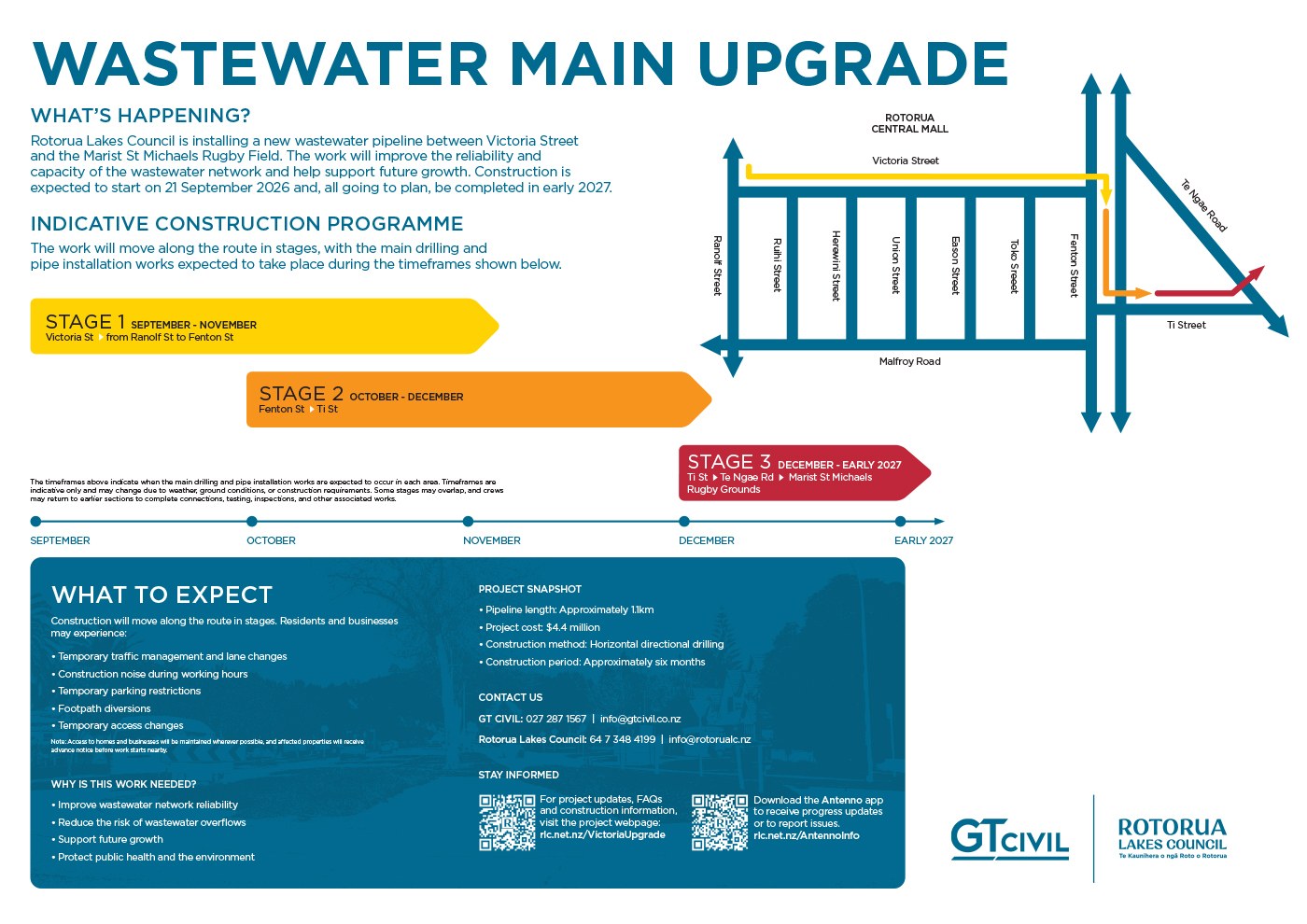
The Depot Street Sewer Rising Main Extension will install approximately 1.1 kilometres of new wastewater pipeline from the Victoria Street and Ranolf Street intersection, along Victoria Street, Fenton Street and Ti Street, to a temporary connection at Marist St Michaels Rugby Field.
This new pipeline will help strengthen Rotorua's wastewater network and reduce the risk of future overflows.
Construction is set to start on September 21 and is expected to be finished in early 2027.
Why is this work needed?
Much of Rotorua's wastewater infrastructure is underground is out of sight, but it plays a vital role in everyday life.
As Rotorua grows, the wastewater network needs additional capacity to ensure it continues to operate reliably and efficiently
This project will:
- Improve wastewater network capacity
- Increase reliability and resilience
- Reduce the risk of wastewater overflows
- Help protect public health
- Help protect the environment
- Support future growth and development across Rotorua
Project at a glance
Project: Depot Street Sewer Rising Main Extension (Stage 1)
Location: Victoria Street, Fenton Street and Ti Street
Length: Approximately 1.1km
Construction period: September 21 2026 to early 2027.
Contractor: GT Civil
How will the pipeline be installed?
The project will primarily use a construction method known as Horizontal Directional Drilling (HDD).
Rather than digging a trench along the entire length of the route, specialised equipment drills an underground pathway and pulls the new wastewater pipe into place.
This approach helps reduce surface disruption while allowing the new pipeline to be installed beneath roads and other infrastructure.
What can people expect during construction?
While horizontal directional drilling reduces disruption, some temporary impacts will still occur during construction.
These may include:
- Temporary traffic management
- Reduced on-street parking
- Changes to vehicle access
- Pedestrian detours
- Construction noise
- Large construction equipment on site
- Temporary water outages for some properties
Anyone affected by planned water outages will be notified in advance.
Keeping access open
Council and GT Civil will work closely with residents, businesses, property owners and community organisations throughout construction.
Access to properties will be maintained wherever possible and stakeholders will receive advance notice of upcoming work and any changes that may affect them.
What is the Depot St Rising Main Extension project?
The project involves installing about 1.1km of new wastewater rising main from the Victoria Street/Ranolf Street area, along Victoria Street, Fenton Street and Ti Street, to a temporary connection at Marist St Michaels Rugby Field.
What is a wastewater rising main?
A wastewater rising main is a large underground pipe that pumps wastewater through the network to where it can be treated.
Why is this project needed?
The project will improve the capacity and resilience of Rotorua's wastewater network, support future growth and reduce the risk of wastewater overflows.
What is Stage 1 of the project?
Stage 1 involves extending the wastewater rising main from Victoria and Ranolf Streets to Marist St Michaels Rugby Field, where it will temporarily connect to the existing wastewater network.
Why is the connection at the rugby field temporary?
The connection at Marist St Michaels Rugby Field is an interim arrangement. It will remain in place until Stage 2 of the project, which will connect the rising main to the Wastewater Treatment Plant, has been confirmed and constructed.
What is Stage 2?
Stage 2 is a separate future project that will connect the rising main to Rotorua's Wastewater Treatment Plant. Further planning and approvals are required before this stage can proceed.
How will the pipeline be installed?
The preferred construction method is horizontal directional drilling. This allows much of the pipeline to be installed underground, helping to minimise disruption to residents, businesses and road users.
Will there still be construction impacts?
Yes. While directional drilling reduces disruption, there will still be construction activity including excavation pits, traffic management, temporary access changes, noise, parking restrictions and work areas along the route.
Will there be traffic delays?
Traffic management will be in place throughout the project. Depending on the construction stage, there may be lane closures, reduced parking, detours or temporary changes to pedestrian and cycling access. Advance notice will be provided where possible.
Will access to my property be maintained?
The project team will work closely with residents and businesses to maintain access wherever possible. If temporary access changes are required, affected property owners or occupiers will be contacted in advance.
Will businesses remain open during construction?
Yes. The project team will work closely with businesses to minimise disruption and maintain customer access wherever practical. Businesses affected by nearby works will receive advance notice.
Will there be any water outages?
Some planned water outages may be required during construction. If this occurs, affected customers will be notified at least 48 hours in advance.
How long will construction take?
Stage 1 is expected to be finished in early 2027 to complete, subject to weather, ground conditions and other project requirements.
Why isn't the pipeline being connected directly to the wastewater treatment plant now?
The project is being delivered in stages. Stage 1 provides important wastewater network improvements now, while planning for the future connection to the Wastewater Treatment Plant continues.
Who is carrying out the work?
The project is being delivered by Rotorua Lakes Council, with GT Civil responsible for construction and day-to-day stakeholder engagement.
How will I know when work is happening near me?
Residents, businesses and property owners affected by the works will receive advance notice. This may include letters, door-to-door visits, emails, Antenno notifications and updates through Council communication channels.
Where can I get project updates?
The project webpage will be the primary source of project information, including updates, timelines, maps and key milestones. Updates may also be shared through Antenno, social media and other Council communication channels.
Where will the work take place?
The project route runs from Victoria and Ranolf Streets, along Victoria Street, Fenton Street and Ti Street, to Marist St Michaels Rugby Field.


