FOGO Organic Waste Collection
FOGO is here!
We expect a high volume of enquiries during the first few weeks as everyone adjusts to the new service. Our teams will be working hard to resolve issues as quickly as possible. Please be patient and kind 🫶
What is FOGO?
FOGO stands for food organic, garden organic waste. It's a kerbside collection service for food scraps and garden waste.
Properties in the collection zones A or B and some in zone C (CBD) will have an 80L, green-lid FOGO bin collected weekly.
What can go in your FOGO bin?
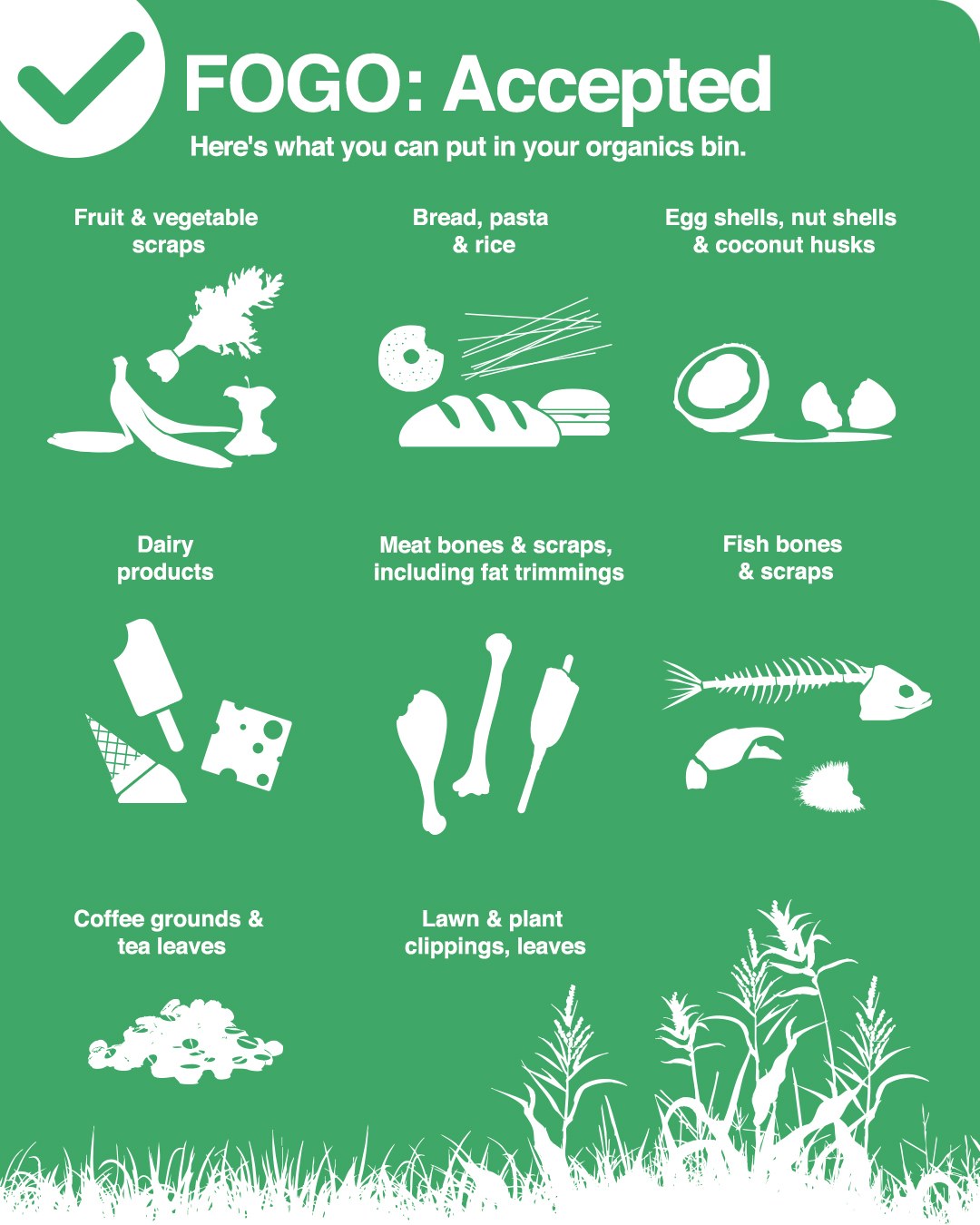
Food waste accepted:
- Fruit and vegetable scraps, including peelings, cores, stalks and skins
- Bread, pasta and rice
- Dairy products
- Meat bones and scraps, including fat trimmings
- Fish bones and scraps
- Egg shells, nut shells and coconut husks
- Coffee grounds, tea leaves.
Note: Newspaper is accepted for wrapping food scraps or lining your bin
Garden waste accepted:
- Lawn clippings
- Small soft branches, twigs (the maximum size for branches and/or logs is 5cm in diameter).
- Leaves
- Weeds.
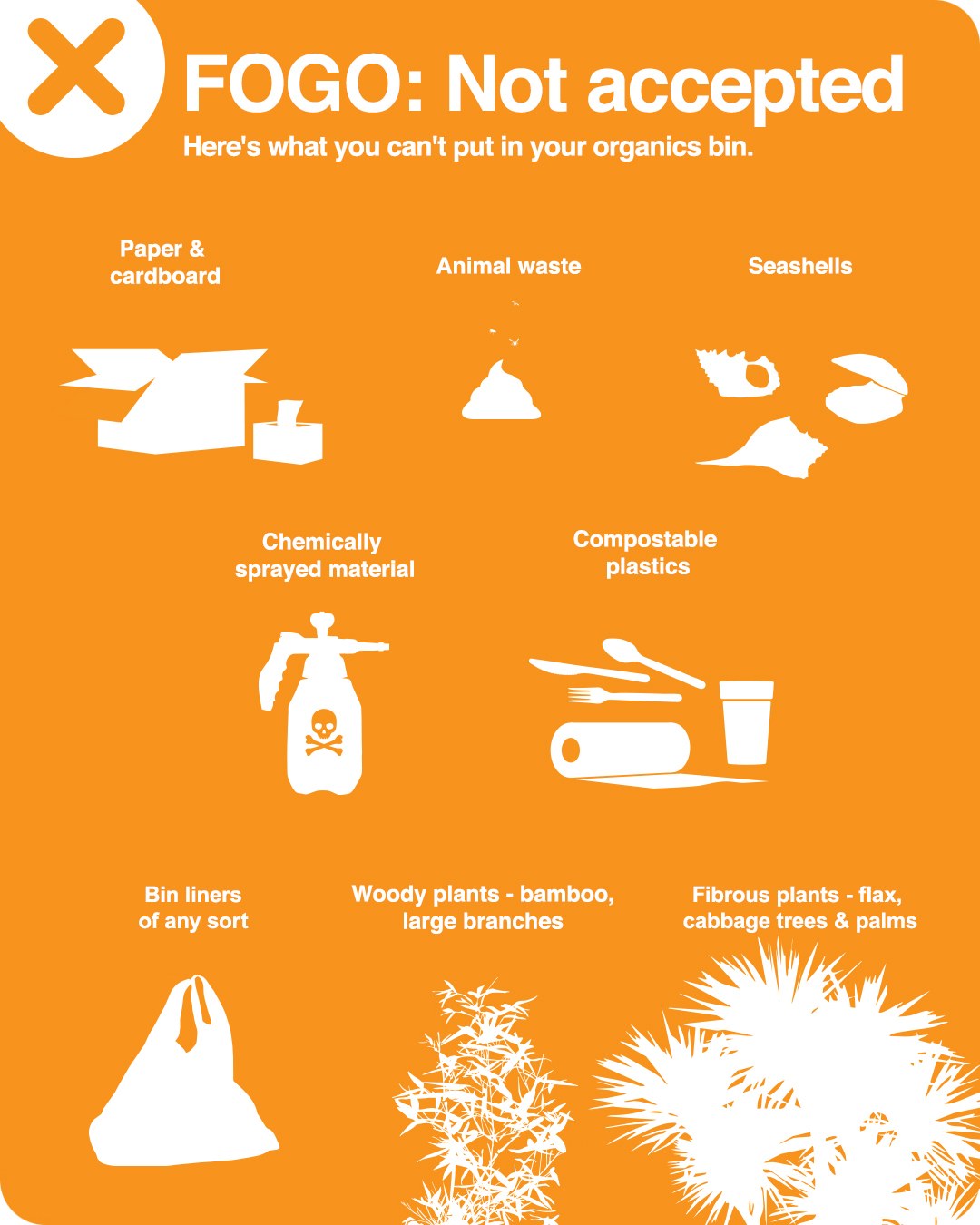
What should NOT go in your FOGO bin?
- Bin liners of any sort
- Plastic bags, bottles, trays, containers, wrap, strapping or plant pots
- Fast food wrappers, bags and boxes with a plastic or wax coating
- Treated wood, timber, sawdust, wood shavings, large logs or stumps
- Bricks and concrete
- Flax, palm, cabbage tree and rhubarb leaves
- Gravel and dirt/soil
- Metal objects
- Disposable nappies
- Liquids like cooking oils
- Tea bags (these often have plastic in them - only loose leaves can go in)
- Paper and cardboard including kitchen paper towels, hand towels and serviettes, shredded paper, food-soiled cardboard containers
- Compostable packaging including compostable plastic products or packaging, compostable paper or cardboard products or packaging, compostable labels
- Human or animal waste
- Ash
- Soil
- Coffee/takeaway cups or lids
- Seashells
- Fibrous or woody plants
- Garden material likely to contain chemical spray or residue
- Insulation, including wool-based products.
Where is the organic waste taken?
The waste from FOGO bins will be taken to Ecogas in Reporoa and processed using anaerobic digestion. The facility generates electricity, heat, biogas and fertiliser as a by-product, closing the food and energy loop by returning nutrients back into local soils.
Watch this video to see more about what Ecogas does.
Frequently asked questions
Bin basics
What if I need a bigger rubbish bin?
We strongly encourage you to be aware of what you are throwing away and think about whether there are ways this could be reduced – check out some top tips on our website: Reducing Waste.
If you do need extra rubbish space, extra or larger bins, check out the pricing and available bins from Smart Environmental.
Can I put compostable products (e.g. bin liners/bags/doggie poo bags, baking paper, wet wipes, coffee cups) in my FOGO bin?
No. Biodegradable/compostable bags, liners, products and packaging should not go in the FOGO bin. These will generally have a paper or plastic base (materials which are not accepted in this bin) - these all go into the red bin for landfill.
Can I use a bin liner?
No, bin liners of any kind should not be used as they cannot be accepted for FOGO processing.
None of the materials which might be used to line a bin or wrap waste (e.g. plastic, compostable plastic, paper) are able to be accepted for this processing and it is very difficult to get these out once they're mixed in with collections.
Give your FOGO bin a rinse out with the hose after each collection to reduce build-up of residue and odours. You can use newspaper to wrap food scraps.
How do I keep my FOGO bin from smelling?
There are a number of things that can help reduce odour from your FOGO bin, including:
- Reducing food waste before the bin is needed – use leftovers before they expire, take care in food purchasing and preparation to reduce waste
- Keeping a dedicated ‘food scraps’ container in the bottom or your fridge or freezer to chill smelly items until collection day
- Layering scraps with garden waste
- Sprinkling scraps with baking soda
- Hosing out the bin after each collection
- Storing the bin in a shady spot and keep the lid closed.
Are RLC providing smaller indoor caddies?
No – we encourage households to re-purpose another container to be used as an indoor caddy. We took this approach because:
- Not all households want to use an indoor kitchen caddy, and those who do will have different spaces and preferences. This approach supports households to use something which matches the look, space and function flows of their kitchen
- Re-use/re-purposing is a great way to reduce waste! Much better than Council purchasing thousands of new plastic caddies.
How is the FOGO bin different to a compost bin?
FOGO bins can work in compliment with home composting systems you might be using at home. There are many food materials which are not recommended for home composting (unless you are using a bokashi system) which can be put into your FOGO bin. These include for example:
- Meat and bones
- Processed foods
- Dairy products
- Problematic weeds, lawn clippings, citrus, onions and other items which can cause problems with your compost if used too heavily.
How do I know I’m putting the right stuff in?
Random checks will be undertaken on bins to ensure the correct materials are inside.
Your bin may be stickered if there are significant issues with the contents. The sticker should say what materials were found – and whether the bin was able to be emptied or not. Significant contamination will likely mean your bin is not emptied, as this would introduce too much wrong material into the truck body. If this happens, you will need to remove problem material and wait until your next collection day. In most cases, collection trucks will not return to collect bins which have been stickered for that collection.
If you need help with correct sorting of your waste and recycling, please get in touch with Council (07) 348 4199 – we want to help!
Can I put 'pest plants' in my FOGO bin?
Yes. Most common pest plants found in residential gardens can be placed in the FOGO bin without affecting the digestion process or the quality of the resulting fertiliser.
However, tougher plant materials such as flax, palm fronds, and cabbage tree leaves must not go in the FOGO bin. These should be taken to the landfill transfer station instead, as they are not considered green waste.
Additionally, large woody material, regardless of species, should also be excluded because it is not suitable for FOGO processing.
My household generates extra rubbish due to medical or care needs. What options are available?
We recognise that some households, particularly those managing incontinence, disability, age-related needs, or caring for someone with a medical condition, may generate more rubbish than others. When developing the FOGO service, Council considered community feedback, local waste data, and the experience of other councils across New Zealand.
While we understand that some households have additional waste needs, the service cannot be tailored to individual circumstances. To help meet different household needs, larger rubbish bins will continue to be available on a user-pays basis. This approach is considered the fairest across the wider community while ensuring all households have access to a food scraps and garden waste collection service that diverts a significant portion of waste from the red-lid bin.
Households needing extra capacity can arrange a larger bin through Council on (07) 348 4199 or Smart Environmental. Additional charges apply.
Assisted collection is also available for residents who are unable to place their bins out due to mobility or health reasons. Contact Council to apply or find out more.
What happens if I live in a multi-unit dwelling or apartment?
Many multi-unit dwellings, fenced communities or apartments have different kerbside collection arrangements that have been discussed and finalised with the residents. For organics diversion, Council will continue to have a flexible approach and work with the residents and communities concerned.
Collection information
Is my property included in the FOGO collection area?
If your property is within Zones A or B, you should have a green-lid FOGO bin. Check your collection zone and collection days using the collection day search tool or check the collections calendar to confirm.
* Some food premises in the designated CBD area (Zone C) receive a 140‑litre FOGO bin. Businesses that generate large amounts of food waste can request extra bin capacity from the service provider for a fee. Very large commercial operators will continue to manage their own waste.
Zones D & E do not receive the FOGO service and have weekly rubbish collections instead.
What's my collection day and which bins go out each week?
Check your collection zone and collection days using the collection day search tool. If you're in zone for FOGO:
- Your FOGO bin is collected weekly.
- General rubbish (red-lid) will be collected fortnightly, alternating with mixed recycling (yellow-lid) and glass (blue crate).
A collection calendar is available in print and online to remind you of collection days. On your collection day, put out:
- Rubbish week: red bin + organics bin
- Recycling week: yellow bin + blue glass crate + organics bin.
In the CBD:
- Food‑registered businesses within the central CBD will receive a 140L FOGO bin which will be collected weekly
- Non-food registered businesses and residential units within the CBD will not automatically receive a FOGO bin but can opt in if they need one.
Outside of the CBD but within FOGO zone:
Your business will be included in the FOGO service and will receive a FOGO bin which will be collected weekly.
Why did rubbish collections move to fortnightly?
About half of kerbside waste is organic. The change simply separates this into two bins, so food and garden waste go in the green bin. Most households should now have less going into the red bin.
For households with higher-than-average waste needs, bigger or additional rubbish bins can be requested (for a fee) from Smart Environmental - contact them on 07 346 8327 or email ro@smartenvironmental.co.nz to discuss.
How'd we get here?
Why did RLC introduce FOGO?
The new FOGO bins will help reduce household organic waste going to landfill, encourage recycling, and support waste reduction.
Food and garden waste makes up over half of local household waste. This service aims to:
- Divert 6,000 tonnes of organic waste from landfill each year
- Halve kerbside landfill waste and cut Council’s waste management carbon footprint by 80%
Landfill space is becoming an increasingly scarce resource. By diverting reusable and recoverable materials away from landfill, we can maximise the value of the investment already made in these facilities. In addition, central government has increased - and is likely to continue increasing waste levies over time. Together, these factors will drive up the cost of landfilling in the future.
How did we define the service area?
The new service will provide an 80-litre bin to all households and businesses in the urban and primarily residential areas of the district. It will exclude all rural areas south of Waipa, rural agricultural areas north of Lake Rotorua, due to too few collection points and long travel distances, which are not economically or environmentally viable. Ōkāreka and Mamaku are also excluded.
A weekly rubbish collection will remain in place for those living outside the organic collection areas.
Factors taken into consideration in determining the service area included travel distances and the need to have sufficient collection points to ensure the service would be economically and environmentally viable.
How was the decision made?
Council approved the introduction of a food organic and green organic waste collection service in July 2024. Council previously signalled its intention to introduce kerbside organic waste collection in the Long-term Plan 2021-2031 and in its Waste Management and Minimisation Plan 2022-2028. Community consultation in 2022 attracted 371 submissions with 85 per cent of respondents supporting an organics/green diversion option.
In May 2023, the Infrastructure and Environment Committee approved a Food Organics Green Organics collection, with fortnightly collection of rubbish, as a preferred option following public consultation. Submissions received during public consultation held in May/June 2022 favoured a mixed collection of both food and garden waste (FOGO), ahead of four other options.
Most respondents who supported the FOGO option (71%), also supported a proposal to change rubbish collection frequency from weekly to fortnightly.
Read the Waste Management & Minimisation Plan 2022-28 (PDF, 11.4MB)
Where can I find previous FOGO updates?
7 May 2026 - FOGO start date delayed
7 July 2025 – Minutes of meeting relating to Council decision to award FOGO contract released. Release of Council decision made on 3 July 2024
Minutes of Infrastructure and Environment Committee Meeting - Wednesday, 3 July 2024
7 January 2025 – Media enquiry about various elements of the new organics collection service: 7 January 2025 - Rotorua Lakes Council
6 January 2025 – Contract awarded to organic waste collection service: Contract awarded for organic waste collection service - Rotorua Lakes Council
31 October 2024 – Organic waste collection part of annual plan discussions: 2025/2026 Annual Plan discussions begin - Rotorua Lakes Council
30 August 2023 – Media enquiry and RLC response re food and organic waste collection progress: 30 August 2023 - Rotorua Lakes Council
29 May 2023 – Rotorua a step closer to reducing waste carbon footprint through introduction of green and food waste collection: Council plans to reduce waste emissions - Rotorua Lakes Council
11 May 2023 – Procurement for organic waste collection to progress: Infrastructure and Environment Committee decisions - Rotorua Lakes Council
16 May 2022 – Community consultation on proposed organic waste collection: Organic Waste Collection (FOGO) | Participate Rotorua Lakes Council
What councils have similar systems and fortnightly rubbish collection?
Many other Councils already use this system allowing them to keep costs down while maintaining the same volume waste removal across each fortnight. They include: Tauranga, Hamilton, New Plymouth, Thames-Coromandel, Hauraki and Matamata Piako, Waimakariri, Timaru, Mackenzie, Waimate, Dunedin, Otago, Christchurch, Invercargill, Gore, Grey, Westland and Blenheim.
Costs
If my property is not in the service area, do I still have to pay for this service?
No, properties outside of the FOGO zone will not be charged for the service and will continue to have weekly rubbish collection.
Can I return my FOGO bin?
Properties within the service zone can’t opt out of the new service. Like water, sewage, and roads, everyone in the area contributes to the cost. The service supports the Government’s Emissions Reduction Plan and could cut Council’s carbon footprint by up to 70%. You may return the bin if you don’t want to use it, but you’ll still be part of the service if you’re in the zone.
How much is this costing ratepayers?
The new service has gross annual operating costs of $2.45 m, partly offset by reduced landfill costs of about $1.6 m (from diverting 6,000 tonnes of waste), resulting in a net increase of:
Residential (80l bins): Targeted rate of $27.52 inc. GST per year. For households that use the service this equates to approximately 51 cents per collection.
CBD (140l bins): Targeted rate of $55.04 inc. GST per year for CBD food premises in the FOGO service area.
While diverting organic waste reduces landfill expenses, it also adds a new collection cost. Landfill savings help offset this but don’t make the service fully cost neutral; the targeted rate increase covers the additional cost. Landfill costs continue to rise due to Central Government levies and changes to the Emissions Trading Scheme, which account for around 60% of landfill expenses.
Why do I have to pay for FOGO from July if collections don't begin until October?
The FOGO rate funds the full cost of establishing and delivering the service, not just the weekly collections. This includes planning, procurement, bin purchases, IT systems, communications, contract management, and bin deliveries, which begin from 27 July.
Although collections will now start on 1 October due to supply chain delays, many of these costs have already been incurred and Council continues to invest in preparing the service for launch.
Rates are set annually through Council's planning and rating process and fund the overall service, rather than being based on the number of collections received.
FOGO question? Email: FOGO.Kerbside@rotorualc.nz