


Recycling Information
Kerbside recycling bin collections
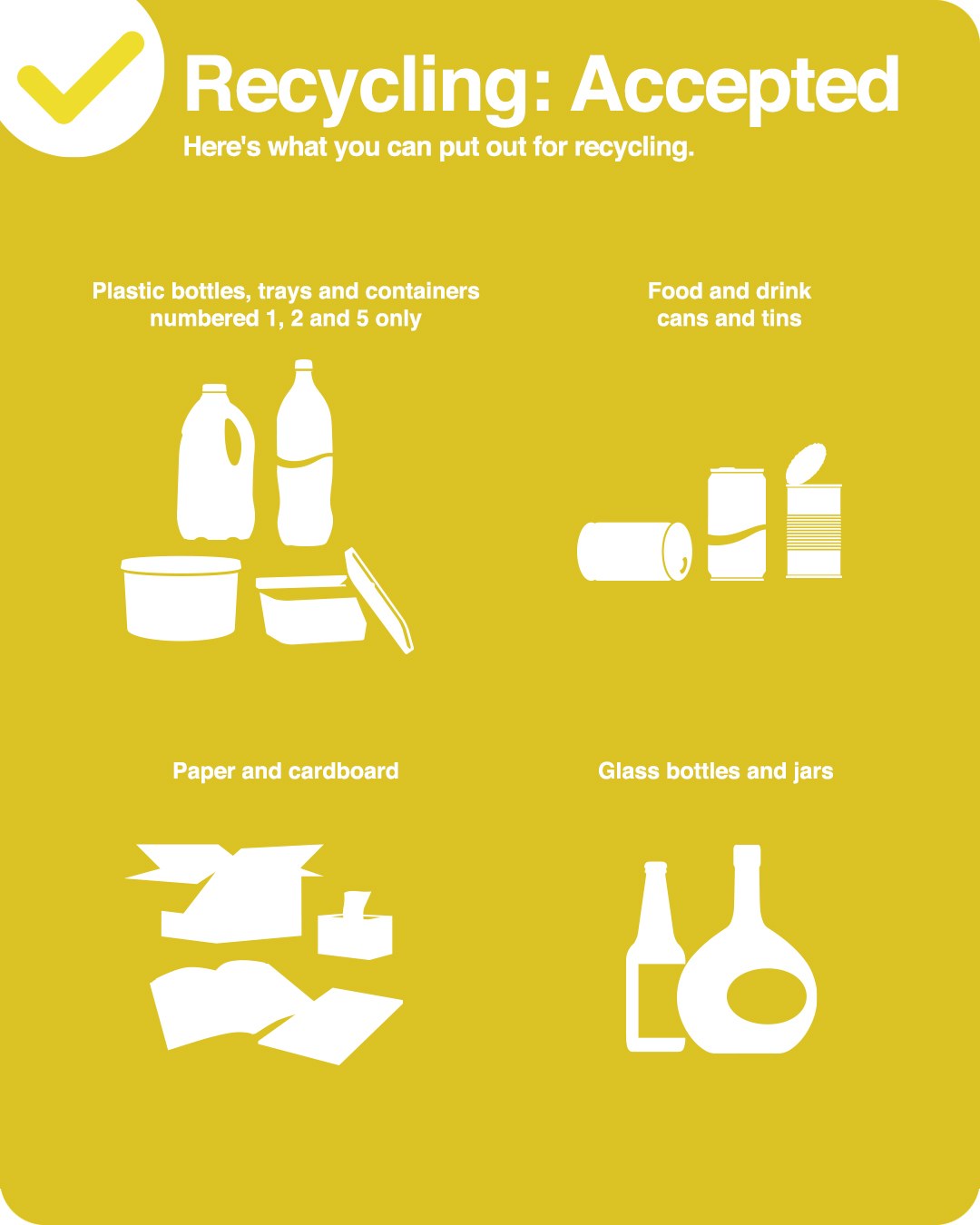
What goes where? Find out what items you can put in your yellow-lid recycling bin and blue glass crate and how to avoid contamination.
In your yellow-lid recycling bin:
- Plastic bottles, trays and containers numbered 1, 2 and 5
- Paper and cardboard (including pizza boxes)
- Food and drink tins and cans.
In your blue crate:
- Glass bottles and jars (with lids removed).

Recycling tips
Kerbside recycling is now the same across the country so it’s easier for everyone to know what goes in each bin, no matter where they are. It also means businesses can make packaging that’s recyclable everywhere, and recycling plants can process more because the materials are cleaner and more consistent.
How to prepare items for recycling:
- Take off plastic lids to dispose in your rubbish bin, and fold food tin lids into the can or place inside and squeeze shut
- Rinse out any dirty items - a quick scrub out in cold water is enough. Save time by rinsing your recycling while you’re doing your dishes
- Sort your items into the right bins.
You don't need to remove product labels, apart from on plastic drink bottles with large sleeves. Plastic lids should not go in your recycling as they are too small to be separated by machinery at recycling plants.
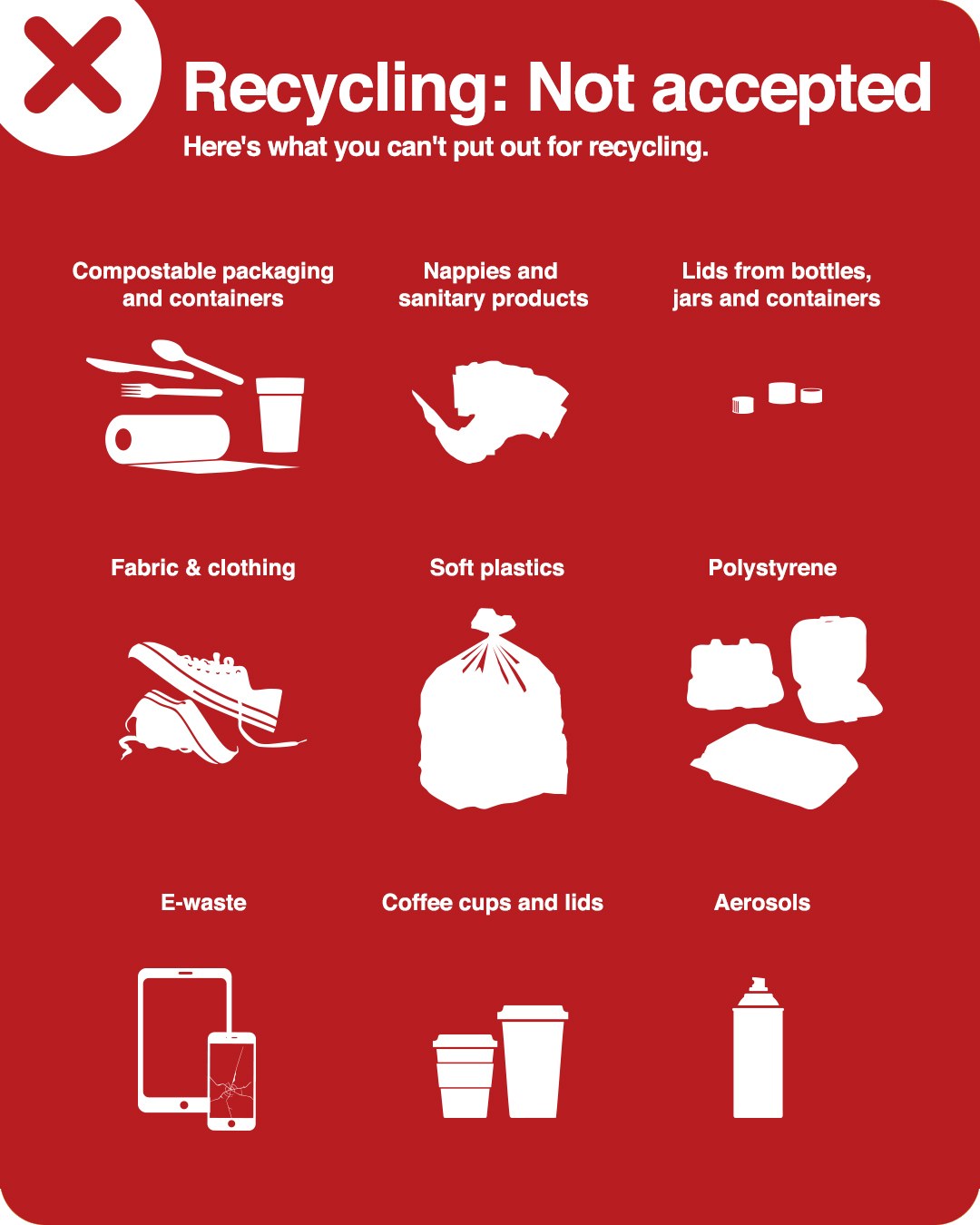
Let's recycle right
Learning to recycle right helps us all - recycling contamination costs ratepayers unnecessarily and has a negative impact on our environment. Contamination means:
- Any items which are not on the list above of "what can be recycled"
- Any items (including recyclables) which are very dirty or still have food or product in them
- Recyclable items which have been put into the wrong bin, for example a glass container which has been put into the yellow-lid bin.
Why does contamination matter?
Contamination can ruin recyclable items so they can’t be reused. Recycling plants get huge volumes every day, so staff can’t clean or sort out dirty items, especially when they’ve been sitting for days. Dirty or broken items can also be unsafe for workers and can damage equipment.
Some of the most common contaminants found in our recycling collections include:
- Dirty items – recyclable items with food or liquid still in them, oily paper or cardboard, used nappies
- Soft plastics – cling film, plastic bags, bubble wrap, zip lock bags, foil chip packets
- Single use coffee and drink cups – these can look like cardboard but usually have a plastic lining
- Liquid paperboard (e.g. Tetra Pak) – long-life milk, almond milk or liquid stock packaging
- Polystyrene (e.g. Styrofoam)– appliance packaging, packaging ‘peanuts’, takeaway containers
Help your whānau learn what to recycle and what not with our downloadable recycling colouring sheet. (PNG, 1MB)
What happens to your recycling
Watch what happens to your recycling at our regional sorting facility in Kopu in this YouTube video. This materials recovery facility is managed by our contractors, Smart Environmental.
Learn more about recycling
Rotorua Lakes Council can provide presentations or workshops to support groups and individuals in understanding recycling information and processes. If you would like to find out more, please get in touch with recycling@rotorualc.nz.
Why can't I recycle plant pots?
Some plant pots are plastic #5 and some aren’t but they can look identical. Plant pots are mainly black. Black plastic can’t be recognised by optical sorters so they end up not being recycled. The NZ Plant Producers Institute is working on how best to increase the reusability and recyclability of plant pots and recover them for recycling.
Are aerosols a health and safety hazard?
When not completely empty, aerosols can explode under pressure and cause fires at recycling facilities. Some aerosols contain poisonous contents such as insecticides and automotive sprays. Staff at recycling facilities may be exposed to these contents when aerosols are damaged or crushed for baling.
Why can't we recycle other plastics?
Plastics numbered 3, 4, 6 and 7 can't be recycled via our kerbside collections as these plastics are hard to recycle and low in value. New Zealand doesn't have the required infrastructure to process large volumes of these onshore and there are limited opportunities in offshore markets.
Many product and packaging companies are moving toward using plastics 1, 2 and 5 because of their higher recyclability and value. You can help support this change by buying fewer products made from hard-to-recycle plastics.
Some material programmes separate to Council collections can collect and recycle some of these materials, for example, Soft Plastics Recycling.
How can I tell if something is recyclable?
Metals are usually easy to identify – if it is a clean food tin or drink can, it will be recyclable.
Papers and cardboards are often easy as well but watch out for composite materials. This means paper or cardboard products which also have plastic or aluminium layers, like drink or milk cartons, powdered drink or formula cans. These layers can't be separated easily and therefore aren't suitable for kerbside recycling. Gift wrap is usually not suitable for recycling as it can contain plastics. An exception to this, and good alternative, is brown kraft wrap.
When checking plastics, look only for the plastic identification code. This will be a small triangle with a number inside, usually on the packaging itself or on the label. If the number is a 1, 2 or 5 the item is recyclable via your kerbside bin. If you cannot find the identification symbol, it is better to put this item in your rubbish bin as likely it is a mixed plastic and not suitable for recycling.
This factsheet from Plastics New Zealand provides more information on plastic types.
If you have any questions or would like support with your recycling, get in touch with recycling@rotorualc.nz.


